
Blog
Sydneebeeyxo: Everything You Need to Know About the Rising Online Name

In a digital world obsessed with speed, virality, and loud personal branding, sydneebeeyxo stands out precisely because it doesn’t try too hard. It represents a growing shift in how online identities are built, perceived, and trusted especially among digitally fluent audiences who value authenticity over algorithms. For startup founders, entrepreneurs, and tech professionals, the rise of sydneebeeyxo offers more than curiosity value. It provides insight into where digital influence, branding, and community engagement are heading next.
At first glance, sydneebeeyxo might look like just another online handle. But beneath the surface, it reflects a broader cultural and technological movement: the evolution of personal brands that grow organically, communicate consistently, and build loyalty without relying on aggressive growth hacks. Understanding why this matters can help modern businesses and digital creators rethink how they present themselves online.
Understanding the Meaning Behind Sydneebeeyxo
The name sydneebeeyxo doesn’t follow conventional branding logic. It isn’t a polished corporate label or a keyword-engineered domain. Instead, it feels personal, slightly abstract, and intentionally human. That’s exactly why it works.
In today’s digital economy, names like sydneebeeyxo resonate because they blur the line between personal expression and digital identity. They are memorable without being manufactured, distinctive without being forced. For digital readers and professionals who navigate crowded online spaces daily, this kind of naming signals authenticity and individuality.
More importantly, sydneebeeyxo functions as a flexible identity. It can represent a creator, a digital persona, a niche brand, or a community hub. That adaptability is increasingly valuable in an era where platforms change quickly, but identity needs to remain consistent.
Sydneebeeyxo and the Shift Toward Authentic Digital Branding
Traditional branding models focused on polish, scale, and uniformity. Modern digital branding, however, is moving in the opposite direction. Sydneebeeyxo reflects a trend where people connect more deeply with brands that feel human, relatable, and imperfect.
This shift is especially relevant for startups and founders. Early-stage companies rarely win by outspending competitors. They win by out-connecting them. A brand presence inspired by the sydneebeeyxo approach prioritizes voice, values, and consistency over sheer reach.
Rather than broadcasting messages, this style of branding encourages conversation. It invites audiences to follow a journey instead of a campaign. That’s why such identities often develop highly engaged communities, even without massive follower counts.
Why Sydneebeeyxo Appeals to Tech-Savvy Audiences
Tech professionals and digital natives are highly sensitive to inauthenticity. They recognize over-optimized content, forced trends, and artificial personas instantly. Sydneebeeyxo appeals to this audience because it feels native to the internet, not engineered for it.
There is also a psychological element at play. Abstract yet personal identifiers create curiosity. They encourage exploration rather than instant judgment. This is particularly powerful in decentralized digital environments where trust is built slowly, through repeated exposure and consistent tone.
For entrepreneurs building products or personal brands, this highlights an important lesson: clarity matters, but so does intrigue. Sydneebeeyxo strikes that balance by being approachable without over-explaining itself.
The Role of Sydneebeeyxo in Community-Driven Growth
One of the most notable aspects of the sydneebeeyxo model is how it supports community-first growth. Instead of chasing visibility everywhere, this approach focuses on depth within a specific audience.
Community-driven identities grow through shared values, recurring interactions, and a recognizable voice. Sydneebeeyxo exemplifies this by functioning less like a broadcast channel and more like a digital gathering point. People don’t just consume content associated with it; they participate.
This has direct implications for startups and digital platforms. Communities built around authentic identities tend to be more resilient. They survive algorithm changes, platform shifts, and market noise because they are anchored in trust rather than reach.
Sydneebeeyxo as a Case Study in Modern Digital Presence
To better understand how sydneebeeyxo fits into the modern digital landscape, it helps to compare it with more traditional online identities.
| Aspect | Traditional Digital Branding | Sydneebeeyxo-Style Identity |
|---|---|---|
| Naming Strategy | Keyword-driven, polished | Personal, abstract, human |
| Growth Focus | Rapid scaling | Organic, community-led |
| Tone of Voice | Corporate or promotional | Conversational and authentic |
| Audience Relationship | Transactional | Relational |
| Longevity | Platform-dependent | Platform-agnostic |
This comparison highlights why many professionals are rethinking how they show up online. Sydneebeeyxo demonstrates that credibility can be built through consistency and sincerity rather than aggressive optimization.
Practical Lessons for Founders and Creators
The real value of analyzing sydneebeeyxo lies in the practical lessons it offers. Founders don’t need to copy the name or style directly, but they can adopt the underlying principles.
First, clarity of voice matters more than perfection. Audiences respond to a consistent tone that feels real. Second, identity should be flexible enough to grow with the creator or company. Sydneebeeyxo works because it doesn’t box itself into a narrow definition. Third, community engagement should be intentional. Growth that comes from genuine interaction is slower, but it is also more sustainable.
These principles apply equally to personal brands, SaaS startups, and content-driven platforms. In each case, the goal is the same: build trust before scale.
Sydneebeeyxo in the Context of the Attention Economy
The attention economy rewards visibility, but it also punishes noise. As more content competes for limited attention, audiences become selective. Sydneebeeyxo thrives in this environment by not demanding attention aggressively. Instead, it earns attention through resonance.
This subtle approach aligns well with how modern professionals consume content. They prefer depth over volume and insight over hype. By focusing on meaningful presence rather than constant output, identities like sydneebeeyxo remain relevant without burning out their audience.
For tech leaders and digital strategists, this suggests a shift in metrics. Engagement quality, retention, and community sentiment may matter more than impressions or follower counts.
The Future Potential of Sydneebeeyxo-Style Identities
Looking ahead, the influence of identities like sydneebeeyxo is likely to grow. As AI-generated content becomes more common, human-sounding, experience-driven digital voices will stand out even more. Authenticity will become a competitive advantage, not just a branding choice.
We can also expect these identities to expand across platforms while maintaining a unified presence. Because sydneebeeyxo is not tied to a single format or channel, it can adapt as new technologies emerge. That adaptability is crucial in a digital environment defined by constant change.
For startups and creators planning long-term growth, this reinforces the importance of building an identity that can evolve without losing its core.
Conclusion: Why Sydneebeeyxo Matters Now
Sydneebeeyxo is more than a name. It represents a mindset shift in digital branding, community building, and online presence. In a world saturated with optimized content and manufactured personas, it shows the power of being deliberate, human, and consistent.
For founders, entrepreneurs, and tech professionals, the takeaway is clear. Sustainable digital influence doesn’t come from shouting the loudest. It comes from showing up with clarity, authenticity, and respect for your audience’s intelligence. Sydneebeeyxo captures that philosophy in a way that feels timely, relevant, and quietly powerful. As the digital landscape continues to evolve, identities built on these principles won’t just survive. They’ll lead.

Public sector hiring stays a nightmare. You’ve seen it if you’ve dealt with government jobs. One opening pulls in thousands of applications. Managers drown in them. Decisions stretch for months.
Remote work made everything messier after 2020. People scattered to home offices. Managers wondered how to tell real work from busywork. That tension didn’t fade. It sharpened.
The tools finally caught up by 2026. And agencies that use them see real differences.
Why AI hiring tools actually matter here
Agencies like USCIS, HHS, and local election offices still get buried. A single posting can draw 500 qualified people or more. Manual screening eats weeks. AI cuts it to days.
These systems scan resumes, flag issues, and rank candidates. Some run initial video interviews and score answers. The goal isn’t replacing humans. It’s clearing the pile so humans focus on people, not paper.
Speed wins big. Filling a data analyst or epidemiologist role in two weeks beats three months. Budgets don’t idle. Work moves.
The monitoring side of remote work
Remote setups need accountability. Some agencies now use activity tracking software. It’s not brand new, but the detail level jumped.
Not every tool feels right. Some cross into heavy surveillance. Others stay measured. For agencies wanting responsible options, https://controlio.net/employee-monitoring.html gives insights while respecting boundaries.
Transparency changes everything. Tell employees upfront what gets tracked and why. Pushback drops. Secrecy destroys trust fast.
The sneaky problem nobody admits out loud
Employees game the systems. Mouse jigglers. Automation scripts. They create the appearance of work without doing it. This happens more than agencies want to admit.
Fake data ruins decisions on staffing, reviews, or workloads. https://controlio.net/blog/activity-falsification-is-skewing-your-productivity-data.html breaks down how modern systems spot unusual mouse patterns, robotic clicks, and scripted behavior.
Controlio software stands out here because it flags these tricks without turning every desk into a spy movie.
Where this plays out in real agencies
Election offices ramp up monitoring during crunch times to protect sensitive systems. Makes sense when votes are on the line.
Health departments lean on AI hiring for specialists. Need lab techs or analysts fast? Speed saves lives in outbreaks.
Smart agencies avoid all-day blanket tracking. They focus on critical tasks. Full surveillance tanks morale. Targeted checks work better.
Trust beats tools every time
You can install fancy software or keep people bought in. Secretive approaches make both impossible.
Best agencies spell it out. They use AI because it’s quicker and often fairer. They monitor remote work for accountability. But they don’t sugarcoat it.
Some states now write rules around this: transparency mandates, tracking limits, regular audits. Smart move.
What actually works right now in 2026
Use AI for the hiring grind. Deploy monitoring where it fits. Stay honest about both. Let staff ask questions. Fix falsification so your numbers mean something.
Agencies pulling ahead treat tech as a helper, not a boss. They get better results when people understand the setup and buy into the why.
The shift feels real. Less theater. More practical fixes. Actual progress on problems that dragged for years.

The real-time rendering technique has revolutionized the way industries have gone about visualizing, reviewing, and refining their digital projects. With the advent of virtual worlds, architectural tours, product visualization, and interactive experiences, the industry demands instant feedback without any trade-off in terms of image quality.
On the other hand, for business leaders and individuals making decisions, there has been an ever-growing need for hardware that matches the requirements posed by increasingly sophisticated rendering processes.
1. The Evolution of Real-Time Rendering
Real-time rendering is now much more than mere previewing or basic visualization processes. Contemporary rendering engines offer nearly photorealistic images while keeping the frame rate interactive, making it possible for people to see changes instantaneously. Workstations that are based on Virtual Reality AMD Ryzen are usually employed for this purpose.
Industries like architecture, games, engineering, and virtual production utilize real-time rendering to make quicker decisions. Visualization makes the process faster and helps avoid delays in projects.
Along with the development of rendering technology, there is an increase in hardware requirements. Systems must process more geometry, textures, lighting effects, and environmental data without creating bottlenecks that interrupt productivity.
2. GPU Performance Drives Modern Rendering
Modern render engines depend on graphics capabilities to create realistic images on the fly. With more powerful graphics acceleration, faster real-time rendering becomes possible, and interactions with complex scenes improve.
Due to techniques such as ray tracing and path tracing, shadows, reflections, and light rays can be calculated instantly. Such a procedure is very demanding on graphics cards, posing serious problems even with simple systems.
Higher-end GPUs have increased VRAM sizes that help maintain scenes with complicated objects and detailed textures without transferring data, which hinders rendering speeds.
3. Managing Larger Assets and Textures
Modern projects contain significantly more visual data than previous generations of content. Large environments, detailed models, and high-resolution materials place continuous demands on workstation resources.
Rendering processes often need 4K and 8K textures, which take a lot of memory resources. Once the available memory runs out, the performance is significantly reduced.
Workstations are built to cope effectively with such tasks. Additional memory resources and fast storage are used to keep navigation smooth even in case the projects become more complex.
4. CPU Power Supports Real-Time Simulations
While GPUs handle visual rendering, processors remain responsible for many background calculations. Physics systems, procedural generation, particle effects, and artificial intelligence all depend on CPU performance.
Modern rendering environments frequently process multiple tasks simultaneously. A workstation must manage rendering, simulations, asset loading, and user interaction without causing delays or dropped frames.
High-core-count processors improve multitasking capabilities while maintaining responsiveness. This becomes especially important when working on large-scale projects that require multiple software tools running at the same time.
5. Workflow Efficiency Depends on Reliable Hardware
Fast rendering alone does not guarantee productivity. Creative teams need systems that remain stable throughout long production sessions without performance fluctuations or unexpected interruptions.
Projects involving Virtual production motion capture hardware require reliable workstation performance because rendering systems must process tracking data, animation updates, and visual outputs simultaneously.
Reliable hardware reduces downtime and allows teams to maintain consistent workflows. Stable systems help organizations meet deadlines while minimizing the risks associated with crashes and performance-related delays.
6. Cooling and Stability Matter More Than Ever
The higher the intensity of rendering work, the more heat is generated. If the thermal solution of your system is not sufficient, then there may be thermal throttling that will slow down the rendering process.
Professional workstations have powerful cooling systems intended for constant loads. With proper temperature control, the components can work at full capacity all the time.
In addition to temperature control, system stability is crucial when rendering or working with visualization tools for long periods of time.
7. Real-Time Collaboration Requires More Processing Power
Modern workflows increasingly involve collaborative environments where multiple stakeholders review projects in real time. Interactive presentations, design reviews, and virtual demonstrations require responsive performance.
Rendering systems must instantly reflect changes while maintaining visual accuracy. Any delays can interrupt collaboration and reduce the effectiveness of the review process.
Powerful workstations make these collaborative experiences possible by providing the resources needed to manage complex scenes without sacrificing responsiveness or visual quality.
Building for the Future of Real-Time Rendering
The need for real-time rendering will only increase with time, with advancements in visual technology that become increasingly more vivid and interactive. Companies that build on a solid workstation infrastructure can easily adapt to future demands.
Various vendors are providing reliable workstation platforms. These include Puget Systems and BOXX Technologies. The two vendors offer good hardware capabilities, but most companies need workstations customized according to their specific rendering needs rather than generic solutions.
Cloud Ninjas stands out due to its customized approach towards workstations for visualization, rendering, and production workloads. Cloud Ninjas’ workstations are customized according to the specific load of workstations used by professionals for real-time rendering projects.
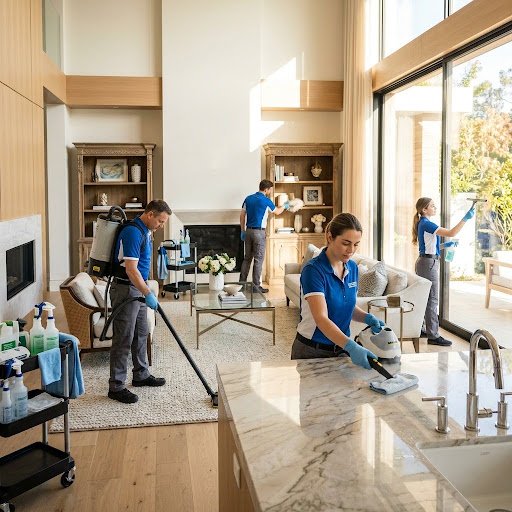
Most people clean their homes regularly—wiping counters, vacuuming floors, scrubbing the bathroom. But no matter how diligent the routine, certain layers of grime, bacteria, and buildup simply don’t respond to everyday cleaning products and quick passes with a mop. That’s where deep cleaning makes all the difference. And when it’s done by the right hands, the results speak for themselves.
Deep cleaning isn’t just a more thorough version of your regular routine. It targets the places most people overlook—behind appliances, inside cabinet hinges, along grout lines, under furniture, and deep within ventilation areas. The difference between a surface clean and a true deep clean is the difference between a home that looks clean and a home that actually is clean.
What Makes Deep Cleaning So Different from Regular Cleaning?
Regular cleaning maintains appearances. Deep cleaning restores a home from the inside out.
Think about your kitchen, for example. A standard clean wipes the stovetop and counters. A deep clean removes the grease buildup behind the stove, degreases the range hood filters, sanitizes the inside of the refrigerator, and scrubs the tile grout back to its original color. Every corner that collects bacteria, every surface that traps allergens—deep cleaning addresses all of it systematically.
Bathrooms receive the same treatment. Soap scum that has hardened over months, mineral deposits on fixtures, and bacteria hiding in caulking lines are all tackled with professional-grade products and techniques. The result isn’t just a cleaner bathroom—it’s a healthier one.
The Real Value of Hiring Deep Cleaning Professionals
Deep cleaning professionals who are trained, equipped, and experienced bring a level of thoroughness to your home that transforms not just its cleanliness, but the overall comfort and air quality your family lives with every single day.
That’s not an exaggeration. Dust and allergens accumulate in places that regular cleaning tools simply can’t reach. Over time, these particles affect air quality, trigger allergies, and create environments where bacteria and mold can quietly thrive. A professional deep clean disrupts all of that.
Beyond the health benefits, there’s the matter of time. A thorough deep clean of a full home can take many hours—hours that most people don’t have to spare. Professionals work efficiently with the right products and tools, completing in a few hours what might take a homeowner an entire weekend.
Areas of the Home That Benefit Most from a Deep Clean
Some spaces in your home accumulate grime at a faster rate than others. Here are the areas where a professional deep clean delivers the most noticeable impact:
The Kitchen: Grease, food residue, and moisture create an environment where bacteria thrives. Deep cleaning targets inside the oven, behind appliances, under the refrigerator, and inside the microwave—areas that rarely get touched during regular maintenance.
Bathrooms: Hard water stains, mildew, and soap scum build up over time. A deep clean restores surfaces and sanitizes areas that harbor the most bacteria in the home.
Baseboards and Trim: These surfaces collect dust and pet hair constantly, yet they’re often skipped during routine cleaning. A professional deep clean includes a thorough wipe-down of every baseboard in the home.
Window Tracks and Sills: Dust, debris, and moisture accumulate here quickly. Left uncleaned, window tracks can become a breeding ground for mold.
Under and Behind Furniture: Moving furniture during a deep clean uncovers buildup that affects air quality and contributes to allergen levels throughout the home.
How Often Should a Home Be Deep Cleaned?
The honest answer depends on the household. Homes with pets, young children, or high foot traffic benefit from a professional deep clean every three to four months. For smaller households without pets, twice a year is often sufficient to maintain a truly clean living environment.
Seasonal deep cleans—particularly in spring and fall—are a practical approach many homeowners take. Spring cleans clear out the buildup from winter months, while a fall deep clean prepares the home for a season spent mostly indoors.
Moving into a new home is another ideal time for a professional deep clean. Even if a property looks clean, previous occupants leave behind bacteria, residue, and grime that a surface clean won’t address.
Why a Professional Deep Cleaning Service Is the Right Choice
A trusted local cleaning team brings professionalism, attention to detail, and genuine care to every deep cleaning service. The crew arrives prepared, with professional-grade products, the right equipment for every surface, and a systematic approach that ensures nothing gets missed.
Every home is different, and a quality cleaning team understands that. Whether it’s a compact apartment or a large family home, the service is thorough, reliable, and designed to deliver results that last. Clients across North Carolina trust a consistent local provider because the quality shows and the difference is visible from the moment the job is done.
A Cleaner Home Is a Better Place to Live
There’s a real and measurable impact that comes from living in a deeply cleaned home—better air quality, fewer allergens, less bacteria on surfaces your family touches every day. It’s not just about appearances. It’s about the environment your home creates for the people inside it.
Booking a professional deep clean is one of the most practical investments you can make in your home and your family’s well-being. The results are immediate, the benefits are lasting, and the experience of walking into a truly clean home is something that’s hard to put a price on.
Ready to experience the difference? Reach out to a trusted local cleaning company today and schedule your deep clean.
-
 Technology8 months ago
China’s High-Speed Rail: A Transformational Journey Through Speed, Innovation, and National Progress
-

 Blog12 months ago
3 Amazing Multi-Purpose Phone Chargers You Need in 2026
-
 Business8 months ago
Top Reasons Stussy Clothing Dominates the Streetwear Scene
-
 Technology9 months ago
Frehf Explained: Understanding Its Impact on Modern Culture
-
 Blog9 months ago
AC Milan vs SSC Bari Timeline: Complete Match History and Key Moments
-
 Blog8 months ago
Unlocking the Mystery: What is Zosqk and Why It Matters
-
 Blog9 months ago
Lustmap24: Your Ultimate Guide to Adult Connections
-
 Blog9 months ago
Exploring Pantagonar: A Hidden Gem in the Heart of Nature